


Search behaviour changed faster between 2024 and 2026 than in the previous decade combined. ChatGPT reached 2.8 billion monthly active users. Google AI Overviews now appear on more than 25% of all queries - up from 6.5% at the start of 2025. Perplexity processes over 780 million searches per month. And across every one of these platforms, the same dynamic plays out: one AI generates one answer, cites two or three sources, and the user never clicks anything else.
If your brand is not in those citations, you are invisible to that user. This is the problem that Answer Engine Optimisation (AEO) was built to solve.
What Is Answer Engine Optimisation?
Answer Engine Optimisation is the practice of structuring, formatting, and positioning your web content so that AI-powered answer engines select it as a source when generating responses to user queries.
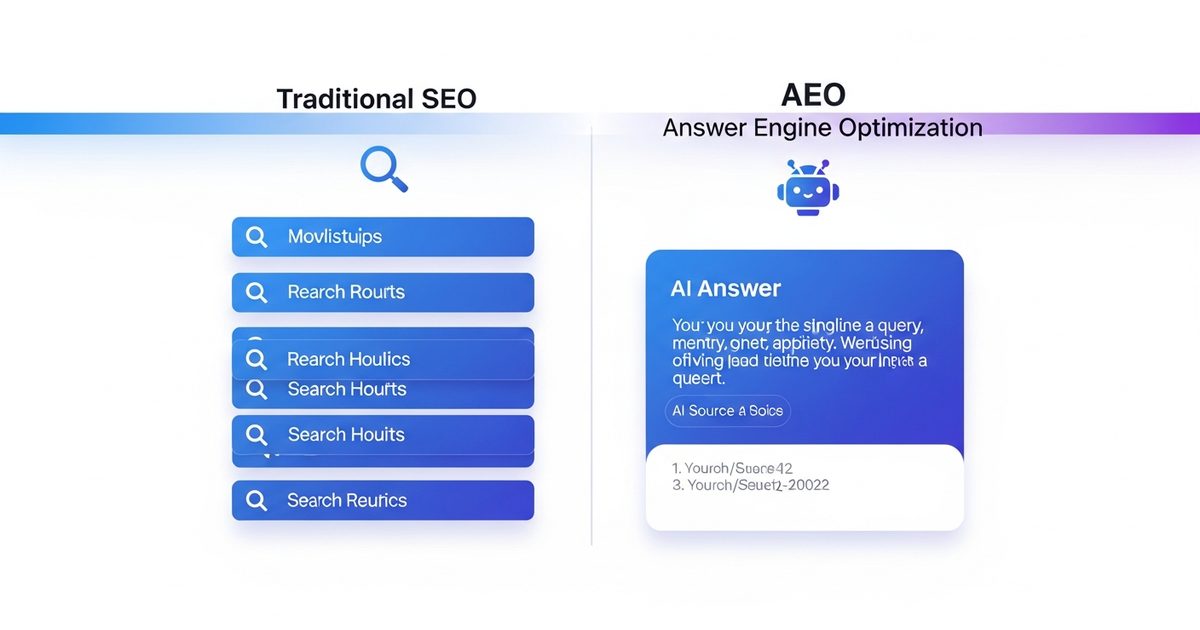
Traditional SEO aims to rank your URL on a search results page. AEO aims to get your content quoted, summarised, and cited inside an AI-generated answer. The goal is not to appear in a list of ten results - it is to be the source the AI engine chooses when it forms its answer.
The distinction matters because AI engines do not rank ten results. They generate one response. If your competitor is cited and you are not, there is no page two to fall back on.
Why AEO Matters More in 2026 Than Ever Before
The scale of AI search growth makes AEO urgent, not optional. Consider the platform data:
AI Engine | Monthly Active Users / Queries | YoY Growth |
|---|---|---|
ChatGPT | 2.8 billion users | Dominant market share |
Google AI Overviews | 25%+ of all Google queries | Up from 6.5% in Jan 2025 |
Perplexity AI | 780M+ monthly queries | 370% YoY |
Google Gemini | 2 billion monthly visits | 647% YoY |
Claude (Anthropic) | ~20 million active users | Growing rapidly |
Alongside this growth, over 60% of Google searches now end without a click - users receive their answer directly from AI Overviews or featured snippets. The zero-click era is not coming - it is here. AEO is the discipline that lets you win visibility even when users never visit your page.
AEO vs SEO: Understanding the Key Differences
SEO and AEO are not competing disciplines - they are complementary, with meaningfully different optimisation targets.
Factor | Traditional SEO | AEO |
|---|---|---|
Goal | Rank in blue-link results | Get cited in AI-generated answers |
Primary signal | Backlinks and keyword relevance | Content structure and answer completeness |
Output format | URL in a ranked list | Brand cited inside an AI response |
Competition model | 10 results per page | 1-3 citations per answer |
Freshness requirement | Moderate | High - AI engines favour recent content |
Schema markup | Helpful | Critical |
Measurement | Rankings and traffic | Citation rate and AI visibility score |
The critical insight is this: a page can rank on page one of Google and never be cited by ChatGPT. And increasingly, a page cited by ChatGPT drives more qualified traffic than a page ranking fourth on Google. Both channels matter - which is why the most effective approach in 2026 is optimising for both simultaneously.
How AI Engines Select Their Sources
Understanding AEO requires understanding how large language models (LLMs) choose which sources to cite. The process varies by platform but follows consistent patterns.
Retrieval-Augmented Generation (RAG)
Most AI search engines use Retrieval-Augmented Generation - a process where the AI first retrieves relevant documents from an index, then generates an answer using those documents as context. Your content needs to pass two gates: the retrieval gate (is your content indexed and crawlable?) and the generation gate (is your content structured well enough for the AI to extract a usable answer?).
What AI Engines Look for in Sources
Direct, complete answers - AI engines prefer content that answers a question fully in one place, rather than content that references the answer elsewhere
Structured formatting - headers, bullet points, numbered lists, and tables help AI engines extract information cleanly
Topical authority - content from sites with demonstrated expertise in a subject area is cited more often than generic coverage
Schema markup - structured data tells AI crawlers exactly what each piece of content is and means
Content freshness - content updated within the last 30 days receives 3.2 times more AI citations than older material, according to BrightEdge research
Site trust signals - HTTPS, fast load times, and established domain reputation all factor into citation selection
The 6 Core AEO Ranking Factors
1. Answer Completeness
AI engines want a single, comprehensive answer - not a teaser that sends users elsewhere. Structure your content to answer the question directly in the first 100 words, then expand with supporting context, data, and examples. Pages that fully resolve a query without requiring additional clicks earn significantly higher citation rates than pages that answer partially and invite the reader to continue.
2. Structured Schema Markup
Schema markup is the most direct signal you can send to AI engines about what your content contains. According to BrightEdge research, pages with comprehensive schema markup earn a 36% advantage in AI-generated citations. Priority schema types for AEO include:
FAQPage - marks up question-and-answer content for direct extraction by AI engines
HowTo - structures step-by-step instructional content into machine-readable format
Article / BlogPosting - establishes content type, author, and publication date
Product - for commercial content with specifications and pricing
Organization - establishes brand identity and entity recognition across AI knowledge graphs
3. E-E-A-T Signals
Google's framework of Experience, Expertise, Authoritativeness, and Trustworthiness applies directly to AI citation selection. AI engines are increasingly sophisticated at distinguishing expert-authored content from generic output. Signals include: author credentials in bylines, first-hand experience demonstrated in the content, citations of original research, and consistent topical depth across your entire domain - not just individual pages.
4. Conversational Query Coverage
AI search queries are longer, more natural, and more specific than traditional keyword searches. Users type "What should I do if my website is not being cited by ChatGPT?" rather than "ChatGPT not citing website fix." AEO requires mapping your content to these long-tail, conversational queries and answering them directly. Natural language processing tools and "People Also Ask" analysis help identify the exact phrasing your audience uses in AI engines.
5. Content Freshness and Update Frequency
AI engines treat recency as a quality signal. A page last updated 18 months ago signals stale information even if the content is technically accurate. Build a content refresh schedule: audit your highest-value pages quarterly, update statistics and examples, and include the update date in your schema markup. Regular updates signal to AI crawlers that your content is maintained, accurate, and reliable.
6. Page Experience and Crawlability
AI engines cannot cite content they cannot read. Technical barriers - slow load times, JavaScript rendering issues, robots.txt blocks, or poor Core Web Vitals scores - prevent your content from being indexed for AI citation regardless of how well it is written. AEO requires a clean technical foundation: fast pages, proper crawl access, and semantic HTML that AI parsers can interpret correctly. Tools like AI Rank Lab's Core Web Vitals Automator surface and fix these issues automatically.
How to Implement AEO: A Step-by-Step Framework
Step 1 - Audit Your Current AI Visibility
Before optimising, establish your baseline. Use AI Rank Lab to run an AEO/GEO audit that checks your site against 100+ factors across content structure, schema implementation, E-E-A-T signals, and technical crawlability. The audit completes in under 60 seconds and identifies your highest-priority gaps - the specific changes that will produce the fastest improvement in AI citation rates.
Step 2 - Map Your Content to Conversational Queries
Identify the questions your target audience asks AI engines. Use tools like AnswerThePublic, Google's People Also Ask results, and AI Rank Lab's Keyword Planner - which surfaces queries specifically optimised for AI citation opportunity. Build a query map that covers: informational queries (what is X, how does X work), comparison queries (X vs Y, best X for Y), and problem-solution queries (how to fix X, why is X happening).
Step 3 - Restructure Existing Content for Direct Answers
Audit your highest-traffic pages and restructure them to lead with direct answers. Apply the inverted pyramid model from journalism: state the answer first, then provide supporting context, then add depth. Add question-formatted H2 and H3 headers that mirror conversational queries. Move key facts and definitions to the top of sections rather than burying them in paragraphs three and four.
Step 4 - Implement Comprehensive Schema Markup
Add structured data to every page. At minimum, implement Article or BlogPosting schema with author and dateModified fields. Add FAQPage schema to any page that covers multiple questions. Use HowTo schema for instructional content. Validate your schema with Google's Rich Results Test and monitor coverage in Google Search Console to catch any implementation errors quickly.
Step 5 - Build Topical Authority Clusters
AI engines assess the credibility of a source based on the breadth and depth of content across a topic. A single article on AEO is less authoritative than a cluster of ten articles covering every dimension of the subject. Build content clusters around your core topics: a pillar article supported by detailed supporting articles on specific subtopics. Internal linking between cluster articles signals topical authority to AI crawlers and improves citation rates across the entire cluster.
Step 6 - Monitor and Iterate
AEO is not a one-time project. Citation rates change as AI engines update their models, as competitors publish content, and as user query patterns evolve. Use AI Rank Lab's AI Visibility Tracker to monitor your citation rate across ChatGPT, Gemini, Claude, and Perplexity on a weekly basis. When citation rates drop on specific queries, investigate the content covering those queries and update it with fresh data, more complete answers, or improved structure.
What Is GEO and How Does It Relate to AEO?
You will encounter both AEO (Answer Engine Optimisation) and GEO (Generative Engine Optimisation) when researching this space. The terms are often used interchangeably, and the practical distinction is minor:
AEO - focuses on earning citations in AI-powered answer engines: ChatGPT, Perplexity, Claude, Gemini as a standalone product
GEO - focuses on generative AI output surfaces more broadly, including Google AI Overviews, Microsoft Copilot, and AI-generated content within traditional search results
In practice, the optimisation strategies for AEO and GEO are nearly identical. Both require structured content, comprehensive schema markup, conversational query coverage, and demonstrated topical authority. AI Rank Lab tracks and optimises for both simultaneously, which is why you will see AEO/GEO referenced together throughout the platform.
Measuring AEO Performance
AEO requires different measurement tools than traditional SEO. You cannot use Google Search Console to see whether ChatGPT is citing your brand. The metrics that matter are:
AI Citation Rate - the percentage of target queries where your brand is cited in AI-generated answers. Track this across each major AI engine separately, as citation patterns vary significantly between platforms.
AI Visibility Score - a composite score of your citation frequency, citation placement (first vs. third source cited), and query breadth. AI Rank Lab's tracker provides this score with weekly updates.
Share of AI Voice - your citation rate relative to competitors for the same query set. Knowing your own citation rate is useful; knowing whether you are gaining or losing ground to competitors is essential for strategic decisions.
AI-Referred Traffic - track referral traffic from AI engines in GA4. While AI-referred traffic is not always fully attributed, it is growing and increasingly measurable. Tag AI engine referral sources in your analytics to track the trend over time.
Common AEO Mistakes to Avoid
Writing for keywords, not questions - AEO requires content that answers complete questions, not content optimised around keyword density or keyword frequency
Ignoring schema markup - content without structured data is significantly less likely to be extracted for AI citation, regardless of how well written it is
Treating AEO as a one-time task - AI engines update their models and citation criteria regularly; AEO requires ongoing monitoring and iteration, not a single implementation sprint
Publishing thin content at scale - AI engines are increasingly capable of identifying generic content and deprioritising it in favour of demonstrably expert sources with original insight
Optimising only for Google - ChatGPT, Perplexity, and Gemini each have distinct citation patterns; a strategy that targets only Google's AI Overviews misses the majority of the AI search landscape
Not measuring AI visibility separately - a page can rank well in Google and have zero AI citations, or vice versa. Tracking both independently reveals where effort will have the greatest impact.
AEO Tools Worth Using in 2026
Dedicated AEO tooling is still maturing, but several platforms now offer meaningful capabilities:
AI Rank Lab - the most complete AEO platform available. Includes a 100+ factor AEO/GEO audit, AI Visibility Tracker across ChatGPT, Gemini, Claude, and Perplexity, Keyword Planner, AI Content Writer, and Core Web Vitals Automator. Free tier available. See how it compares to other tools in the top AI SEO tools review for 2026.
Google Search Console - tracks traditional search performance and schema validation; does not measure AI engine citations directly but remains essential for the technical SEO foundation
Schema validators - Google Rich Results Test and the Schema.org validator for checking structured data implementation
Content optimisation tools - Clearscope and Frase for semantic topic coverage analysis that improves both SEO and AEO performance
For a detailed breakdown of the full tooling landscape, see the guide to the 12 best AEO tools in 2026.
The Future of AEO
AEO is not a temporary trend. Every major technology company - Google, Microsoft, OpenAI, Anthropic, Meta - is investing billions in AI-powered search interfaces. The trajectory is clear: AI-generated answers will handle a growing share of all informational and commercial queries, and the brands cited in those answers will capture a disproportionate share of the resulting traffic and conversions.
The brands winning in AI search by 2027 will be the ones that built their AEO foundation in 2026 - while their competitors were still treating AI citations as someone else's problem. The good news is that the advantage window is still open. Most brands have not yet implemented even the basics: comprehensive schema markup, conversational content structure, and dedicated AI visibility tracking.
Start with your baseline. Run a free AEO audit on AI Rank Lab and see exactly where your brand stands in AI search today - no credit card required.
Frequently Asked Questions
What is Answer Engine Optimisation (AEO)?▾
How is AEO different from SEO?▾
Which AI engines does AEO target?▾
What is the most important AEO ranking factor?▾
Is AEO the same as GEO?▾
How do I measure AEO performance?▾
Get a Free AI Ranking Consultation
Want to improve your brand's visibility in AI search engines like ChatGPT, Gemini, and Perplexity? Fill out the form and our experts will create a personalized strategy for you.

Written by
Devanshu
Chief Marketing Officer & AI Search Optimization Architect
Digital Marketing Strategist & Pioneer in SEO, Answer Engine Optimization (AEO), and Generative Engine Optimization (GEO).


