AI citation tracking: see which URLs AI engines cite
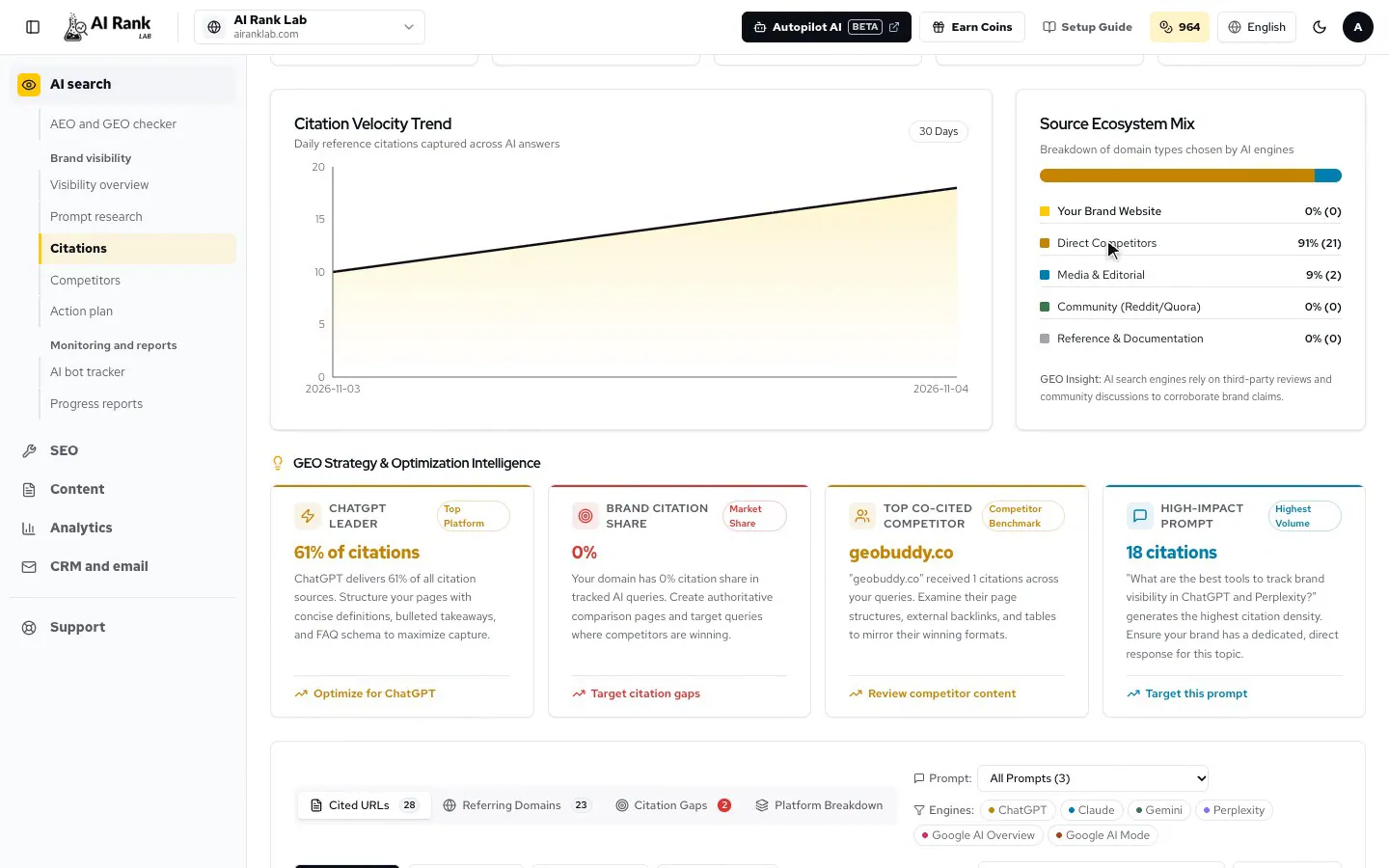
Every prompt run stores the sources ChatGPT, Claude, Gemini, Perplexity, Google AI Overviews and AI Mode cite. Citation analytics groups them by page, domain, engine and prompt, so you see whose content AI trusts for your buyers' questions, and where yours is missing.
Free trial · 3 days · $5 to start · cancel anytime
fieldnote.app4,571 creditsFN
Citations · fieldnote.app
URLs cited across 12 prompts × 6 engines
Illustrative data
Cited URLs
86
from 31 domains
Your pages cited
9
+3 since last runs
Citing engines
5 of 6
not yet Gemini
Rival domains
6
cited next to you
Most-cited URLscitation frequency
fieldnote.app/pricingYour page
pipewise.io/agencies14
g2.com/categories/crm11
reddit.com/r/agency9
Cited domains, by typeshare of citations
Competitors38%
Editorial24%
Your site17%
Community13%
Reference8%
AI engines whose citations are stored
6AI engines whose citations are stored
cited in every run, kept for comparison
Every URLcited in every run, kept for comparison
export of cited URLs
CSVexport of cited URLs
Citations tracked fromChatGPTClaudeGeminiPerplexityGGoogle AI OverviewsGGoogle AI Mode
What is AI citation tracking?
AI citation tracking is recording which web pages AI answers cite as sources for a question, and following those sources over time. AI Rank Lab stores every URL that ChatGPT, Claude, Gemini, Perplexity, Google AI Overviews and Google AI Mode cite when they answer your prompts. Citation analytics then groups them by page, domain, engine and prompt, so you see whose content AI relies on.
A citation is a source the answer links to or names. It is stronger than a mention, because it points the reader at one specific page.
Citation share is how often a domain is cited for your prompts compared with every other cited domain.
AI citation analysis, page by page
Mentions tell you AI knows your brand. Citations tell you which page it trusts enough to send readers to.
Which of your pages get cited
See citation frequency for each of your URLs, the engines citing it, the prompts it is cited for and when it was last seen. Pages that are never cited are listed too.
Citation frequency per URL
Citing engines and citing prompts
Last seen, per page
Your pages that AI engines citeIllustrative
fieldnote.app/pricing5 engines
fieldnote.app/blog/agency-crm3 engines
fieldnote.app/portal1 engine
fieldnote.app/compare/pipewiseNever cited
Open a URL to see the prompts citing it, the engines, and when it was last seen.
Citation share against competitors
Every domain cited for your prompts, ranked by how often it appears. It is the clearest view of AI share of voice at the source level: who AI quotes when it answers your buyers.
Citation share · domains cited for your promptsIllustrative
pipewise.io22%
fieldnote.app17%
g2.com13%
reddit.com10%
hubstack.com9%
Every cited URL, by source type
Cited domains are grouped into competitors, editorial and media, reference and documentation, community and your own site. If review sites and forums carry the answer, that is where your next mention needs to come from.
Cited URLs · this runIllustrative
fieldnote.app/pricingYour page
pipewise.io/agenciesCompetitor
g2.com/categories/crmEditorial
reddit.com/r/agencyCommunity
hubstack.com/blog/agency-crmCompetitor
Citations by engine, including AI Overviews
Perplexity and Google AI Overviews cite differently from ChatGPT or Claude. Compare engines side by side and find the one that never cites you.
We measured how many cited domains survive from one run of a prompt to the next. Most don't.
41%
of cited domains carried over from one run to the next (median).991 successful runs of 45 prompt–engine pairs tracked in AI Rank Lab between 13 February and 30 October 2026. Only pairs with five or more runs are included. Aggregated and anonymised; no customer is identified.
3.6%
of cited domains appeared in every run (median).
44%
of prompt–engine pairs switched between naming a brand and leaving it out at least once.
Pairs where the brand mention flipped, by engine
Perplexity6 pairs66.7%
ChatGPT12 pairs58.3%
Claude12 pairs41.7%
Gemini14 pairs28.6%
One check is a sample, not a measurement. AI Rank Lab stores every run, so you compare answers over time instead of trusting one screenshot.
Watch it work in the real product
Short video lessons from the free AI Rank Lab Academy, recorded in the real product.
Citation analytics shows which URLs AI engines cite when they answer your prompts. AI Rank Lab stores the sources ChatGPT, Claude, Gemini, Perplexity, Google AI Overviews and AI Mode cite in each run, then shows which of your pages are referenced, how often, by which engines and for which prompts, next to the competitor and third-party pages cited instead.
What is AI citation tracking?
AI citation tracking means recording the sources an AI answer links to or names for a given question, and following them over time. A citation is stronger than a mention: the engine points readers at a specific page.
How does AI citation tracking work?
You save prompts and run them on the engines you choose. Each answer's cited URLs are stored with the run. Citation analytics then groups them by page, domain, engine and prompt and compares them with your earlier runs.
Which AI engines do you track citations from?
Six: ChatGPT, Claude, Gemini, Perplexity, Google AI Overviews and Google AI Mode.
Which metrics show where our content is being cited in AI answers?
Citation frequency per URL, the engines citing each page, the prompts it is cited for, when it was last seen, your citation share against other domains and the trend across runs.
Can I track AI Overview citations?
Yes. Google AI Overviews and AI Mode are two of the six engines, so their cited URLs are stored like any other. The AI Overview tracker also shows whether Google shows an AI Overview for a query at all, by country and language.
Why is tracking AI citations important?
People increasingly read the answer instead of the results page. The pages an answer cites are the ones that get the click and the credibility. Citation data shows which content AI already trusts, and which competitor or review pages you need to beat.
How can I improve my citation rate?
Start with the prompts where competitors are cited and you are not. Read the pages that win, then publish a clearer, better-structured answer with facts, comparisons and schema, and make sure AI crawlers can reach it. The Action Plan and AI Content Writer do this from your citation data, and the citation tracker checks the result weekly.
How do I set up a dashboard to track AI citation metrics?
Add your domain, save the prompts that matter, and run them on the engines you care about. The Citations view fills from those runs. Data appears after the first run; there is no background crawl.
Can I track ChatGPT citations on their own?
Yes. Run your prompts with only ChatGPT selected, or filter the Citations view by engine. You see which URLs ChatGPT cited for each prompt, which of them are yours and how that changed across runs. The same works for Gemini, Claude, Perplexity and Google's AI answers.
How can I see which of my pages AI cites most?
Open Citations and look at your own domain. Each of your URLs is listed with its citation frequency, the engines and prompts citing it and when it was last seen, so the pages AI already trusts rise to the top. Pages that are never cited show you where to improve.
How do you measure AI citation share, volatility and decay?
Citation share is your domain's citations divided by all citations for your prompts. Volatility is how much the cited sources change from one run of the same prompt to the next. Decay is a page that was cited and then stops appearing. All three come from comparing stored runs, which is why AI Rank Lab keeps every run.
What is AI citation velocity?
AI citation velocity is how fast a page or domain gains citations across runs, for example after you publish or update it. AI Rank Lab does not reduce it to one score. You read it from the citation trend and from the citation tracker's first-cited week for a new page.
Which citation analysis service is best for AI SEO?
Disclosure: AI Rank Lab is our product. Compare tools on engines covered, whether citations come from your own prompts or a shared index, whether run history is kept and whether you can act on the data. AI Rank Lab covers six engines from your own prompts and links citations to an Action Plan and content writer. Index-based tools can show broader market coverage without setting up prompts.


 ChatGPT
 Claude
 Gemini
 Perplexity
 Perplexity
 ChatGPT
 Claude
 Gemini